What Places Communicate
I was staying with family in Atlanta and needed somewhere to work. I chose a locally owned coffee shop instead of the house. The reasons were ordinary — I wanted quiet, I wanted coffee, I thought a change of environment might help me focus.
That part worked. But something else happened that I didn't expect, and it's the actual reason I'm writing this down.
Within minutes of sitting down, I understood how I was supposed to behave in that room. Nobody told me. There was no sign, no host, no instruction of any kind. I just knew.
It was acceptable to stay for hours. The people around me were there to work, or read, or meet quietly, or think. The pace of the room felt intentional rather than rushed. Ordering something else felt like part of how I was expected to participate, though no one had asked me to.
None of that was written anywhere. I didn't ask anyone. I arrived, sat down, and the room seemed to communicate what it expected of me, and I fell into step with it before I noticed I'd been given anything like an instruction.
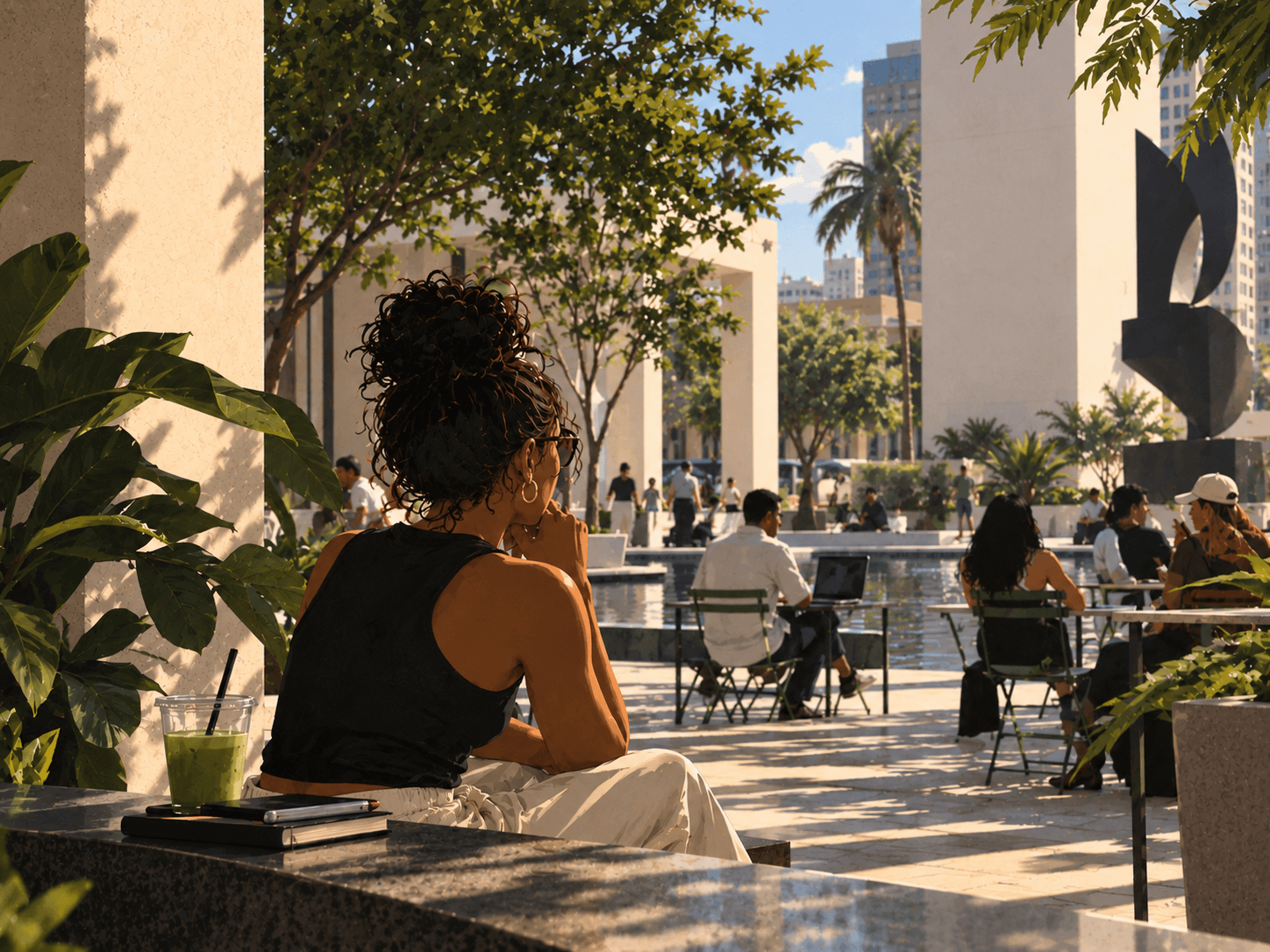
My guess is that this wasn't delivered by any single thing, but by the arrangement of several things at once — the lighting, the spacing between tables, the furniture, the volume of the music, and the visible behavior of everyone already in the room, heads down, unhurried, unbothered by how long they'd been there. There was also something harder to point to directly: the artwork, the materials, the plants, a color palette that felt chosen rather than default — small signs that someone had cared about how this room felt before I ever walked into it. I can't isolate which of these actually did the communicating. I only noticed that something did, and that it worked on me faster than I expected anything to.
Once I had this question in mind, I started reconstructing other rooms that seemed to do the same thing — skating rinks, spas, certain restaurants, nail salons, museums, a handful of public spaces that felt considered rather than default. I'm aware I'm remembering these after the fact, now that I'm looking for the pattern, so I hold them loosely. But the shape is consistent enough that I don't think I'm inventing it entirely: in each of those places, I seemed to absorb a set of expectations about how to act, without anyone stating them.
The comparison that sharpened this for me is Starbucks, where I spend roughly the same amount of money and get a functionally similar product. But the two places don't seem to be communicating the same thing to me at all.
What the coffee shop in Atlanta seemed to communicate:
Stay.
Work.
Linger.
Think.
Contribute.
Settle in.
What Starbucks seems to communicate, in my experience:
Purchase.
Pass through.
Wait briefly.
Continue your day.
Keep moving.
Complete the transaction.
I want to be precise about what that comparison is and isn't. It isn't a claim about Starbucks as a company, or about what its designers intended, or about what other people experience there. It's a record of what I've picked up from that environment, repeatedly, across many locations, over years. Someone else might read the same room differently. I'm only reporting what it seems to ask of me.
One more observation surfaced while I was thinking about this. Looking back, the people around me weren't all doing the same thing. Some were working alone. Some were on calls. A couple were meeting one other person. One pair looked like coworkers, sitting together over open laptops. What they seemed to share wasn't solitude — it was that each of them had arrived with some kind of purpose, and the room let me arrive with mine alongside it. If I had walked in and immediately seen a close friend, I don't think the same thing would have happened. I probably would have said hello, sat with them, and treated the visit as a social one instead of a focused one. I wasn't entering an existing relationship that afternoon, the way I would have with someone I already knew. I think that mattered as much as anything else in the room.
I went to that coffee shop thinking about productivity. I left thinking about something else entirely.
The question I keep returning to isn't why I wanted to stay — wanting to stay was just the outcome. It's how I knew what was expected of me in a room that never told me directly. Lighting, spacing, furniture, the visible care in the materials and details, the people already there — I've named these as candidates, but I don't know which of them actually did the communicating, or whether it only works as some combination specific to that room. That's the part I don't have an answer for.
I'm only beginning to think this might be less about that one coffee shop and more about something places do more generally. I don't yet know if that's true. But it feels like the kind of interpretation worth sitting with longer than one afternoon.
Through what mechanisms do environments communicate behavioral expectations without ever stating them? And is that something everyone in a room receives the same way, or is it possible I arrived that afternoon already prepared to hear it?
This observation led to a broader investigation into how environments influence the way we think, behave, and live.