Designing Movement Into the Workday
What helps or prevents working adults from spending time moving outdoors, and what role does outdoor movement play in their overall well-being?
This is collaborative coursework completed with four other students in Duke University's Human-Centered Design program. The research, synthesis, and concept direction throughout were group work. If this investigation later moves into independent work, that transition will be identified clearly.
Students in the course worked in small groups across different challenge areas. I was assigned to Health and Care Delivery and chose to stay in that group — that assignment, not the course as a whole, set the starting context for this investigation. The problem framing, research, and concept direction below are the group's collective work; my individual contribution was translating the group's concept into the interactive prototypes this case study centers on, detailed in Prototyping to Learn below.
One early direction within Health and Care Delivery focused on encouraging outdoor walking to support mood and reduce anxiety. We deliberately broadened that framing from walking specifically to outdoor movement more generally, so the research itself — not an assumption we'd made in advance — would determine which activities actually mattered to people. Our attention then narrowed to working adults, on the idea that the workday itself — long indoor stretches, sedentary routines, and expectations of availability — might be a specific barrier to outdoor movement.
Secondary research on physical activity and depression, time in nature, outdoor activity and mental health, and everyday movement's physical-health effects supported investigating further, without pointing to one intervention. Because the literature pointed to both mental and physical health outcomes, not mental health alone, we broadened our framing from mental well-being to overall well-being.
We looked more closely at what might be making outdoor movement difficult during the workday. That helped us identify what we still needed to learn directly from working adults.
We developed both a survey and an interview guide, but only the survey — framed around outdoor movement rather than walking specifically — was used to gather the participant responses discussed here, covering work routines, outdoor activity, motivations, barriers, and how people felt before and after spending time outdoors.
The survey was exploratory, with roughly a dozen responses — not a sample we treated as representative. Walking came up repeatedly in how people described outdoor movement: clearing their head, photographing plants, visiting a nature preserve, a podcast on a walk, commuting. With a sample this small, we treated that recurrence as a direction worth exploring, not as a broad conclusion about working adults. It gave us a reason to explore walking in the intervention design.
Our research question became:
What helps or prevents working adults from spending time moving outdoors, and what role does outdoor movement play in their overall well-being?
Framed as a design opportunity: How might we make it easier for working adults to incorporate outdoor movement into their daily routines?
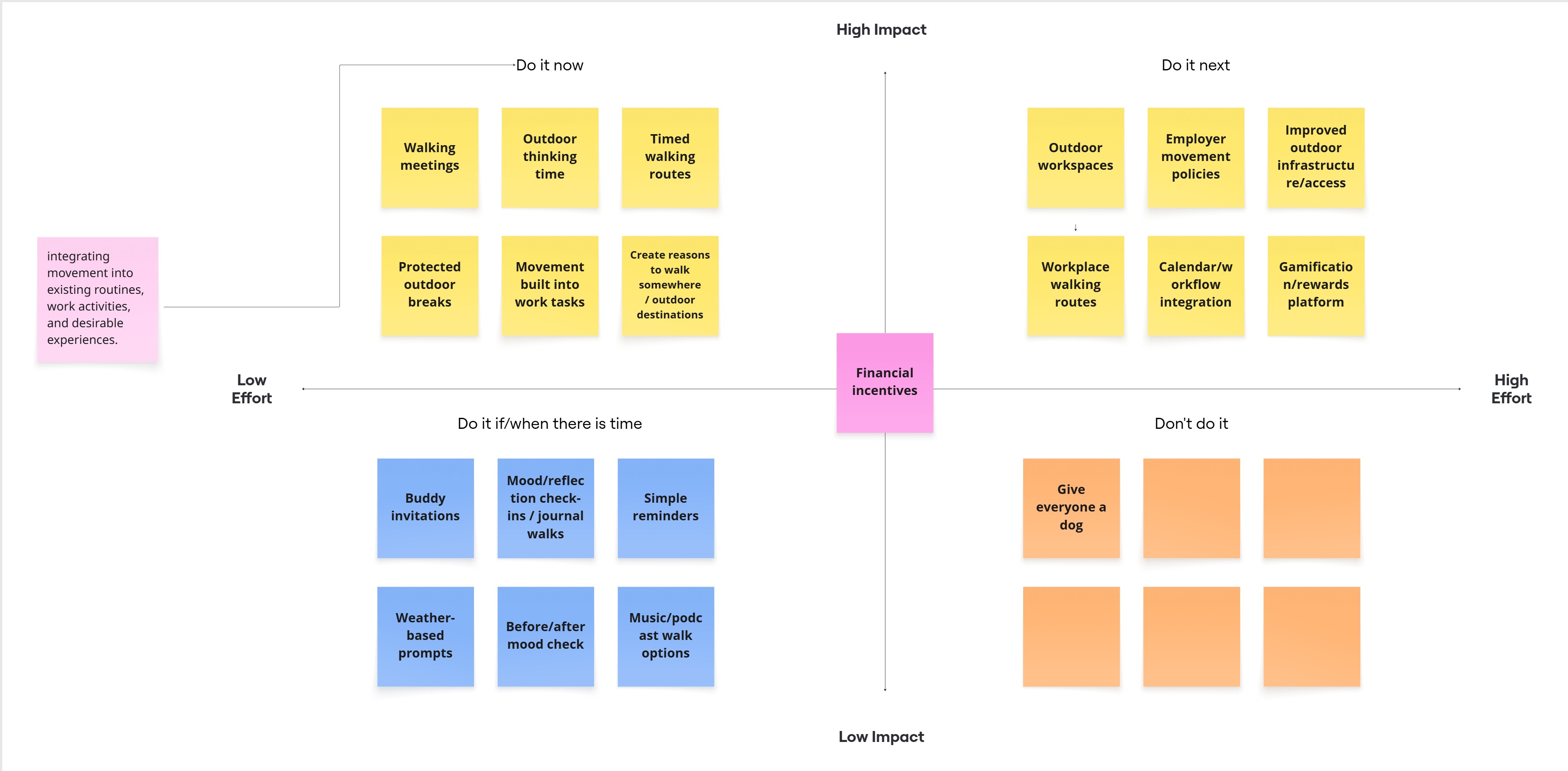
The design opportunity stayed broader than walking. We brainstormed before evaluating anything — walking meetings, protected outdoor breaks, timed walking routes, movement built into existing break tasks, outdoor workspaces, employer movement policies, calendar and workflow integration, gamification, and more — then used an Impact/Effort Matrix to weigh each idea's potential impact against the effort to pursue it. Walking meetings, combined with calendar integration, scored high-impact and low-effort, so that's the idea we chose to develop further — a choice based on the team's judgment, not something the research had proven would work.
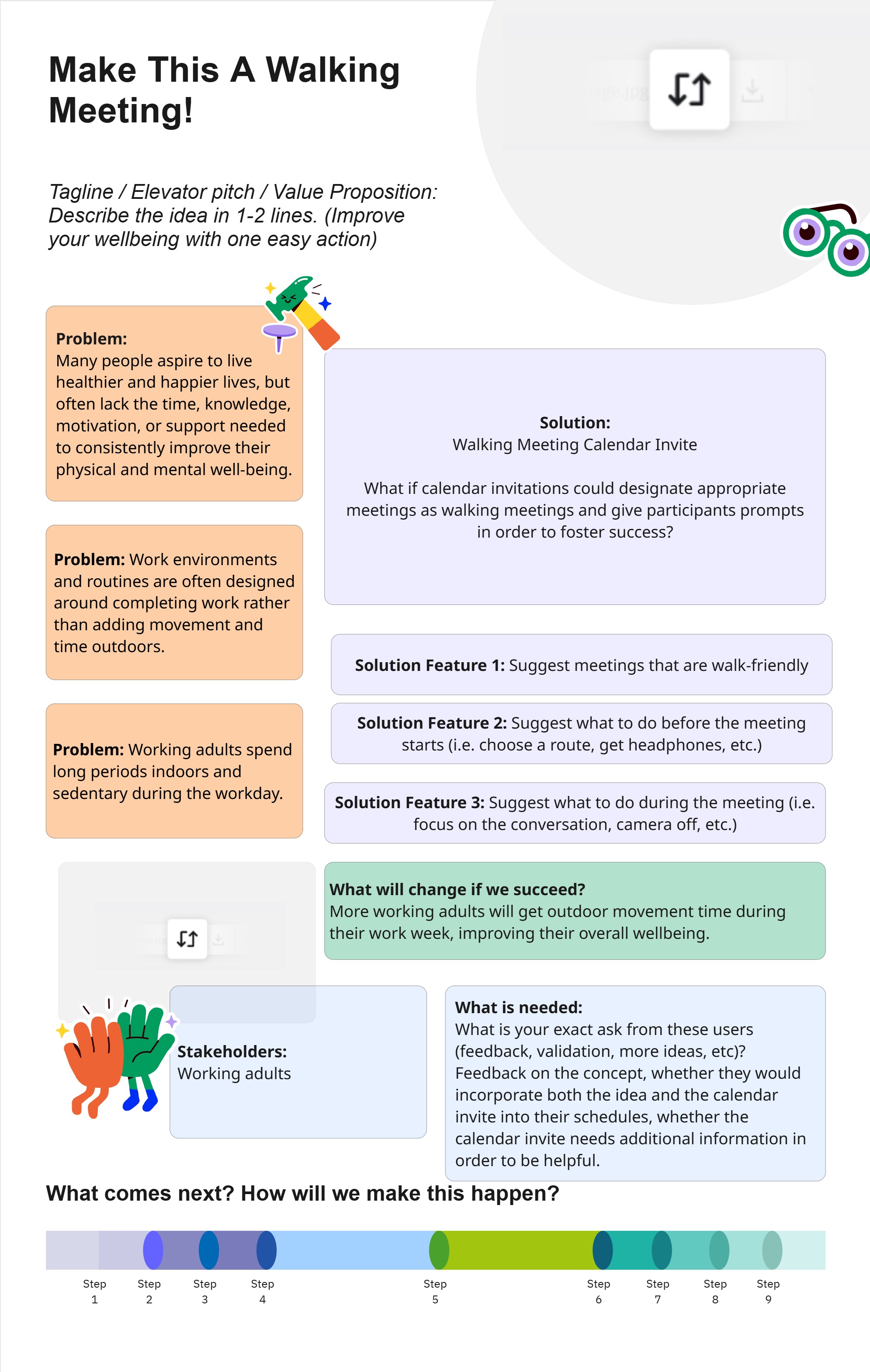
We turned that idea into a concept: calendar invitations that could flag a meeting as a good candidate for walking, with prompts for before (choosing a route, grabbing headphones) and during (staying focused on the conversation, camera off). We shared it as a concept flyer to gather early reactions — not to test whether it worked, but to see whether people understood it, found it relevant, and could imagine using it.
Prototype V1 — Put walking on the calendar
I designed an early calendar interface in Figma to make the group's walking-meeting concept tangible: a weekly calendar view with a walking meeting, showing the before-and-during prompts a participant would see.
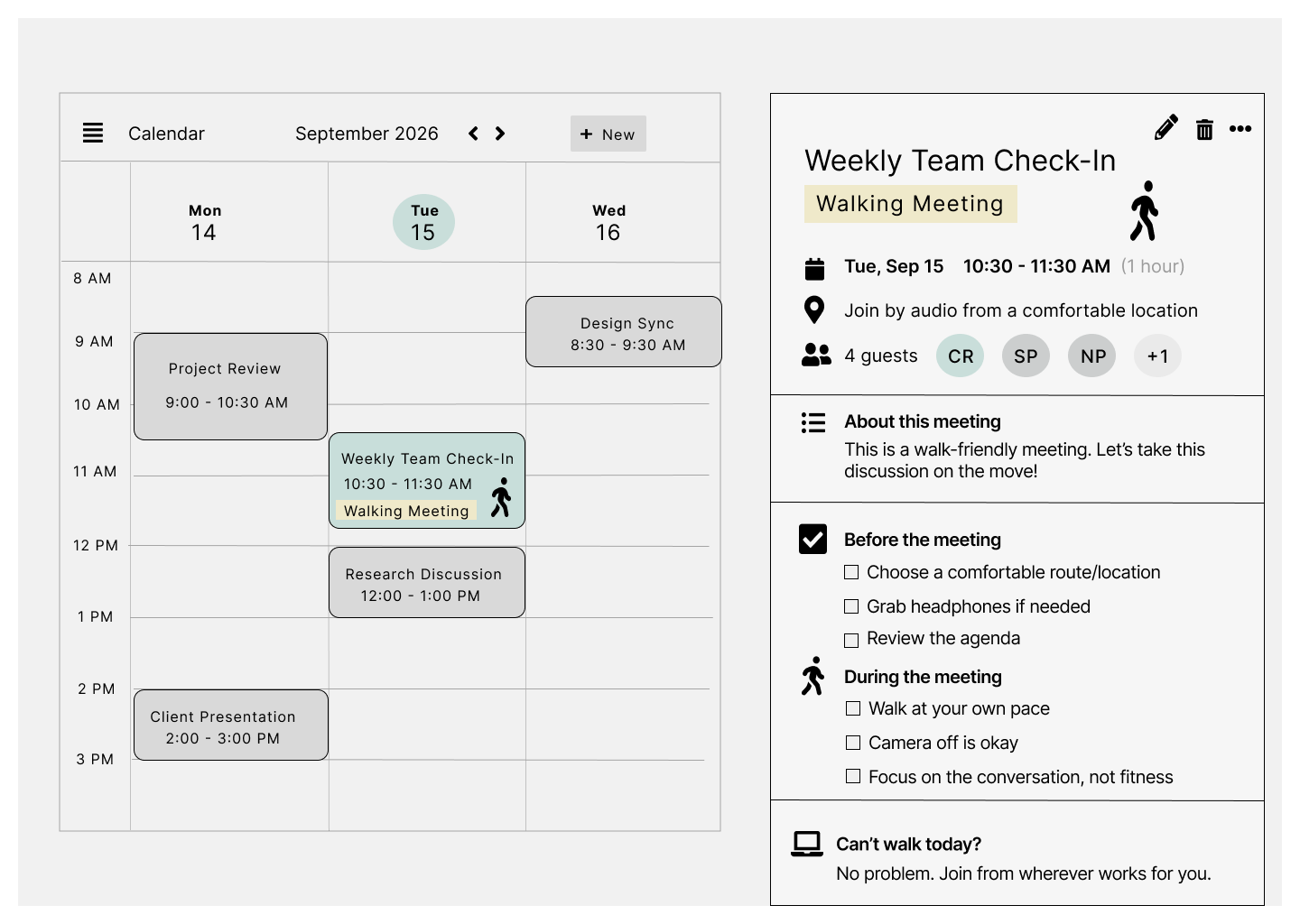
Early reactions to it, including from the instructor, were encouraging. It also raised a question the prototype itself couldn't answer: how does a meeting become appropriate for walking in the first place, and who decides?
Prototype V2 — Define what makes a meeting Walk-Friendly
V2 moved upstream from showing a walking meeting to determining whether a meeting was actually compatible with walking in the first place. The key shift: "Walk-Friendly" describes the meeting, not the person — nobody is told they should walk. A meeting organizer runs a short compatibility check — no required presentation or shared screen, no sustained computer work, the conversation followable by audio, no heavy note-taking — and designates the meeting Walk-Friendly if it holds up, so attendees get an explicit, optional signal.
That's where the design principle permission without pressure comes from: making outdoor movement permissible where it makes sense, without tracking, gamifying, or auto-designating meetings.
As part of an AI-assisted prototyping exercise, I turned this logic into a working HTML prototype.
Another direction — Personal preferences
At the same time, another group member explored a different direction: a prototype using personal preferences to help determine when WalkWise should suggest a walking meeting. Her prototype explored ideas like preferred walking hours, meeting-length limits, exclusions, and other personal rules.
These preferences were part of her design exploration, not findings from our research — nothing about what rules people actually want had been tested. Her direction and my V2 gave the group two different ways of thinking about the same problem: compatibility decided at the meeting level, or preference decided at the individual level.
WalkWise is where I brought the two directions together: the meeting-level compatibility logic from V2, combined with the broader conditions introduced through the group's exploration of personal preferences.
The combined model: the organization sets the conditions → WalkWise identifies a potentially suitable meeting → the organizer confirms → attendees receive the option → the employee chooses. Walking remains optional throughout.
The important shift: the concept had moved from an individual calendar feature toward a broader workplace system.
I used AI-assisted prototyping to bring the combined direction into a working interactive prototype, translating the group's evolving concept into something we could see, navigate, and continue questioning.
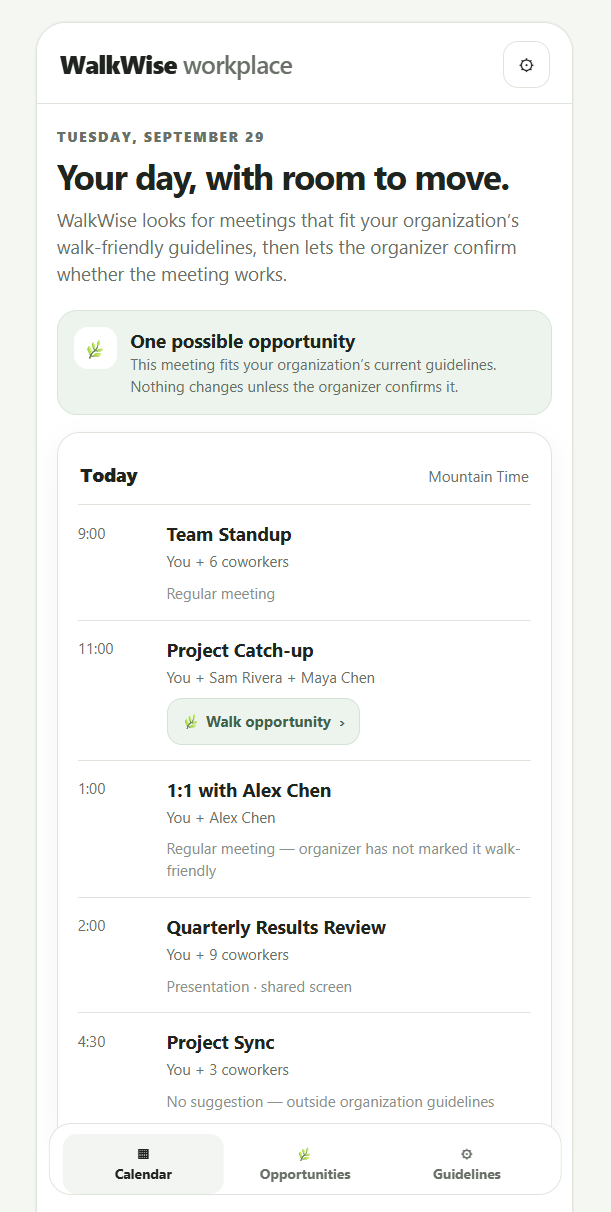
To explore the prototype: select the green “Walk opportunity” label in the calendar.
Explore the interactive prototype ↗
This project changed how I think about prototyping. I started out treating a prototype as something that comes after you've figured out the solution. I left seeing it as part of how you figure the solution out. Each version of WalkWise made a different uncertainty visible and gave us something concrete to question.
It also reinforced something I had been encountering in the course readings: the value of getting a constrained version of an idea into the world early enough to learn from it. The goal isn't to resolve every question before making something. It's to build enough to begin the next iteration.
Working with the group added another lesson. Different prototype directions didn't necessarily mean one person had to be right. My role increasingly became making sense of what each direction was trying to solve and bringing useful pieces together. I learned to protect the logic of the project rather than my attachment to a particular design.
I also learned that staying involved in design doesn't mean I need to own every part of design execution. I can use prototypes, AI-assisted tools, and other lightweight methods to make a direction tangible enough to communicate and test, then work with designers who can take the execution further. From there, I can return to the research: learn from what was made, identify the next uncertainty, and help shape the next iteration.
More broadly, the project clarified what I enjoy most about the design process: understanding the why, working through the problem, translating what I learn into a direction, and staying involved as that direction is tested and refined.
Independent of the group's process, I looked into whether tools supporting walking meetings already existed and found Walking Meetings for Outlook — a tool built around a similar idea. That raised a more interesting question: if tools like this already exist, why isn't this behavior more common in everyday work?
That question came up again during our final class discussion. WalkWise prompted enthusiastic questions about whether the concept could become a real product or calendar plugin. The response was encouraging, but it also reinforced that building the capability may not be the whole problem. If similar tools already exist, the next question is what affects adoption.
Awareness, workplace norms around meetings, and what managers signal about time away from a screen may all affect adoption.
Meeting compatibility, expectations around video, accessibility, weather and location, privacy, hybrid participation, organizational or IT restrictions, and calendar autonomy are all hypotheses worth investigating.
None of these explanations has been tested yet.
Next Questions
- Do organizers understand what makes a meeting genuinely Walk-Friendly?
- Does the signal create real permission to walk, or does it merely communicate that the option exists?
- What role does organizational endorsement play?
- Which meetings are actually compatible with walking in practice?
- What barriers — accessibility, environmental, technological, or social — remain?
- Does surfacing these opportunities actually change behavior?
WalkWise hasn't been tested with users, and none of the outcomes it's designed around — well-being, focus, connection, or productivity — have been measured. The prototypes gave us a clearer intervention and sharper questions to test next. This investigation is complete, but those questions remain open.